


Choosing a location is the single most important decision you will make as a business owner. According to the U.S. Bureau of Labor Statistics, about 20% of new businesses fail within their first two years. While many factors contribute to this, a poor location is a silent killer, quietly draining potential revenue day after day.
I’ve seen this challenge firsthand: selecting a location can feel like a high-stakes gamble, filled with uncertainty and the risk of a costly, irreversible mistake. How can you be sure you’re choosing a neighborhood with the right customers? How do you know if an area is growing or declining?
This guide is designed to replace that guesswork with confidence. I’m going to walk you through a step-by-step framework that uses reliable data to empower you to make a smart, profitable decision. This is the same foundational process I use in my own market intelligence work to help entrepreneurs find the perfect home for their business.
Why Your Location is More Than Just an Address: The Foundations of Site Selection
Before we dive into the process, it’s critical to understand that your location is much more than just a physical address. It’s an active part of your marketing, a powerful driver of revenue, and a core piece of your brand’s identity.
To make the best choice, you need to grasp a few foundational concepts:
- A “Good Area” vs. The “Right Area”: A neighborhood might be bustling and affluent, but if it’s not filled with your specific target customers, it’s the wrong area for your business. The goal is to find a perfect match, not just a popular spot.
- Your Trade Area: Your real customer base isn’t defined by zip code boundaries; it’s defined by convenience. Understanding your trade area—the geographic zone from which you’ll draw the majority of your customers—is essential.
- Demographics vs. Competition: Market research has two core pillars. You need to understand the people in an area (demographics) and the other businesses already there (competition). As I’ll explain, a deep understanding of demographics and competitor analysis is crucial, and it’s vital to know which to look at first.
The Site Selection Process: A 4-Step Framework I Recommend
Over the years, I’ve refined a clear, four-step framework that turns the complex task of site selection into a manageable process. It’s designed to build on itself, ensuring that each step informs the next.
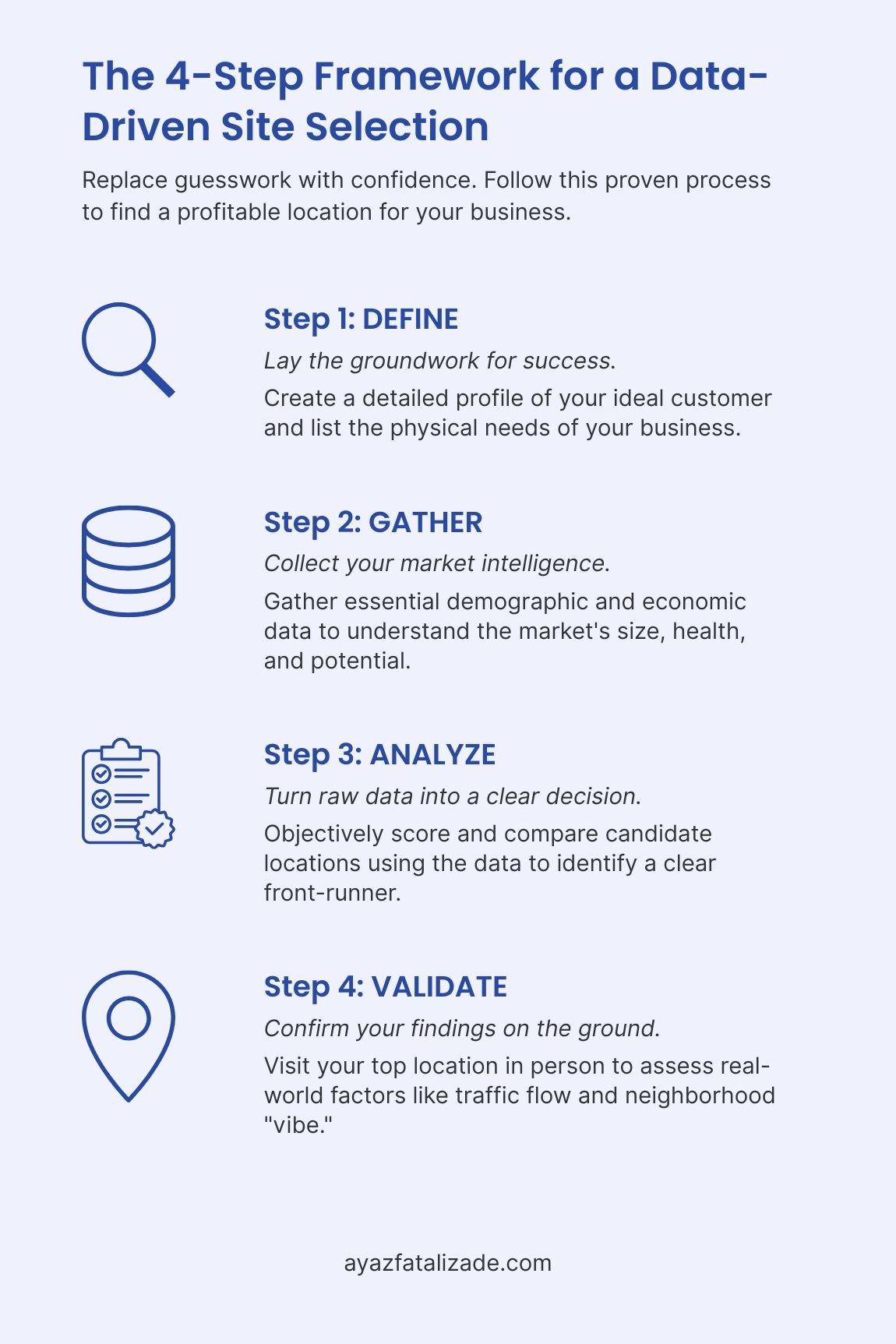
To make this process tangible, I’ll walk you through it with a hypothetical business—a specialty coffee shop called ‘The Daily Grind’—at each step.
Here are the four steps to success:
- Define: Lay the groundwork by defining your ideal customer and physical needs.
- Gather: Collect the essential market data using the right tools and resources.
- Analyze: Turn raw data into insight by scoring and comparing candidate locations.
- Validate: Confirm your data with on-the-ground, real-world validation.
Step 1: Laying the Groundwork – Define Your Ideal Location
The most common mistake I see is entrepreneurs looking at maps and available properties before they’ve defined what they’re actually looking for. Before you ever open a real estate listing, you must first look inward and create a detailed profile of your ideal location.
Creating Your Ideal Customer Profile (ICP)
You can’t find your customers if you don’t know who they are. Start by creating a detailed Ideal Customer Profile based on key demographic and psychographic traits. This is the most critical part of finding your ideal customer.
Case Study Example: For ‘The Daily Grind,’ the ICP isn’t just “people who like coffee.” It’s more specific: “Young professionals aged 25-40 with an above-average disposable income. They value high-quality, ethically sourced products and convenience during their morning commute. They likely work in tech, marketing, or creative fields.”
Defining Your Business’s Physical Needs
Next, translate your business concept into a list of physical requirements. Think about:
- Square Footage: How much space do you actually need to operate efficiently?
- Visibility & Foot Traffic: Do you rely on walk-ins, or are you a destination business?
- Parking & Accessibility: How will customers arrive? Is there ample, convenient parking or public transit access?
- Zoning: Does the area’s zoning permit your type of business?
- Proximity: Do you want to be near complementary businesses (like offices or boutiques) or far from direct competitors?
Step 2: Gathering the Data – Your Market Research Toolkit
With your ideal location defined, it’s time to find areas that match your criteria. This step is all about gathering the objective data that will form the basis of your analysis.
The Power of Demographic Data
Demographics tell the story of the people who live in an area. They are the most reliable indicators of market potential and demand. When I analyze a market, I focus on the 5 key demographic metrics you must analyze: Population Density, Median Household Income, Age Distribution, Household Composition, and Educational Attainment.
Case Study Example: For ‘The Daily Grind,’ we would search for areas with a high population density to ensure a steady stream of customers, a significant concentration of residents in the 25-40 age bracket, and a median household income that suggests residents can afford a premium coffee every day.
Key Economic & Housing Indicators
Beyond basic demographics, you need to know if an area is economically healthy and poised for future success. Key indicators like population growth trends, rising household incomes, and stable home values can tell you if this is a growing area with long-term potential.
Where I Find My Data: Tools & Resources
Free Sources: The primary source for raw demographic data in the United States is the U.S. Census Bureau’s official portal (data.census.gov). It is an incredibly powerful resource, but I’ll be the first to admit it can be complex and time-consuming to navigate, especially for those new to it.
The Value of Synthesis: While raw government data is free, its complexity is why specialized services exist. The power of modern data tools means that from my office, I can perform a detailed analysis for any location in the U.S. with the same precision as someone on the ground. In my work, I use tools that synthesize this information into a professional, easy-to-read report, as it’s the fastest way to get actionable insights without spending days wrestling with spreadsheets and data tables.
Step 3: From Data to Decision – Analyzing Your Candidate Locations
This is where the research transforms into a decision. Once you’ve identified two or three candidate locations that seem to fit your criteria, the goal is to compare them objectively to find the clear winner.
How to Score and Compare Potential Sites
Avoid making a decision based on a “gut feeling.” I recommend creating a simple scoring matrix or checklist to evaluate each location against the key criteria you defined in Step 1. Assign a score (e.g., 1 to 5) for each factor.
Case Study Example: We could score Location A vs. Location B on how well they match the ‘Daily Grind’s’ ideal demographic profile, the level of foot traffic, and the monthly rent costs. Totalling the scores will often reveal a clear front-runner that you might have missed otherwise.
Using Mapping Tools for Visual Analysis
Numbers on a spreadsheet don’t always tell the full story. Using mapping tools to visualize data—for example, creating a heat map of household income levels in your city—can reveal geographic patterns and “hot spots” that aren’t obvious in a table. This visual context is a powerful part of a professional location analysis for retail.
Step 4: The Final Check – On-the-Ground Validation
Data will get you 90% of the way to a confident decision, but it can’t tell you everything. The final, non-negotiable step is to get out of the office and visit your top candidate locations in person.
Your On-Site Visit Checklist
When you visit a potential site, you’re not just looking at the four walls; you’re looking for real-world context that data can’t provide. Here’s what I look for:
- Traffic Patterns: Visit at different times—a weekday morning, a weekday evening, and a Saturday afternoon. How does the flow of people and cars change?
- Condition of Nearby Businesses: Are the neighboring shops well-maintained and busy, or are there vacant storefronts and “For Lease” signs? The health of your neighbors is a reflection of the area’s overall economic vitality.
- Accessibility in Reality: Is the parking lot actually easy to get in and out of? Is the crosswalk safe and convenient for pedestrians?
- The “Vibe”: This is the intangible quality that data can’t capture. Does the character of the neighborhood align with your brand?
- Future Indicators: Look for signs of investment, like new construction projects or public space improvements, which can signal future growth.
3 Common (and Costly) Site Selection Mistakes I’ve Seen
Over the years, I’ve seen entrepreneurs make the same few critical errors that jeopardize their success. Here are the three most common mistakes to avoid.
- Relying on “Gut Feeling” Alone: This is the most dangerous mistake. A location might “feel right,” but if the demographic data doesn’t support that feeling, you are taking an unnecessary and often fatal risk.
- Underestimating the Competition: Finding a neighborhood that perfectly matches your ideal customer is only half the battle. If that area is already saturated with five direct competitors, your path to profitability will be incredibly difficult.
- Skipping the On-Site Visit: I once analyzed a location that looked perfect on paper—great demographics, low rent, high traffic counts. The on-site visit, however, revealed that a massive, two-year road construction project was scheduled to begin right in front of the property, which would have crippled access. The data was right, but it was missing that critical piece of on-the-ground context.
Conclusion: Your Location is Your Foundation
Choosing your business location is a foundational act. Getting it right provides a tailwind that makes everything else—marketing, sales, and operations—easier. Getting it wrong forces you to swim against the current from day one.
By following this four-step framework—Define, Gather, Analyze, and Validate—you can move from uncertainty to confidence. A data-driven approach is the single most important investment you can make in your business’s future success, minimizing your risk and maximizing your potential for profit.
Choosing a location is the first major step. To get ongoing expert advice from me on how to grow your business with data, subscribe to my newsletter for exclusive guides, tips, and tools delivered straight to your inbox.